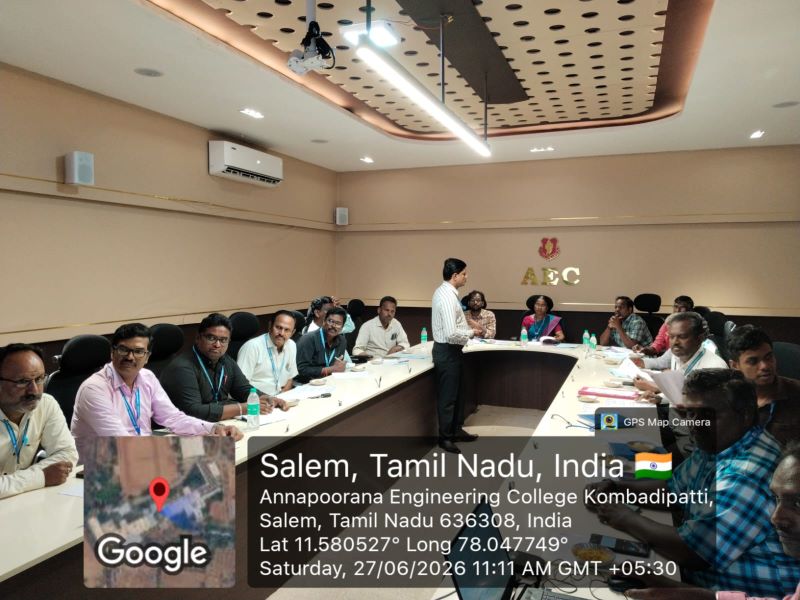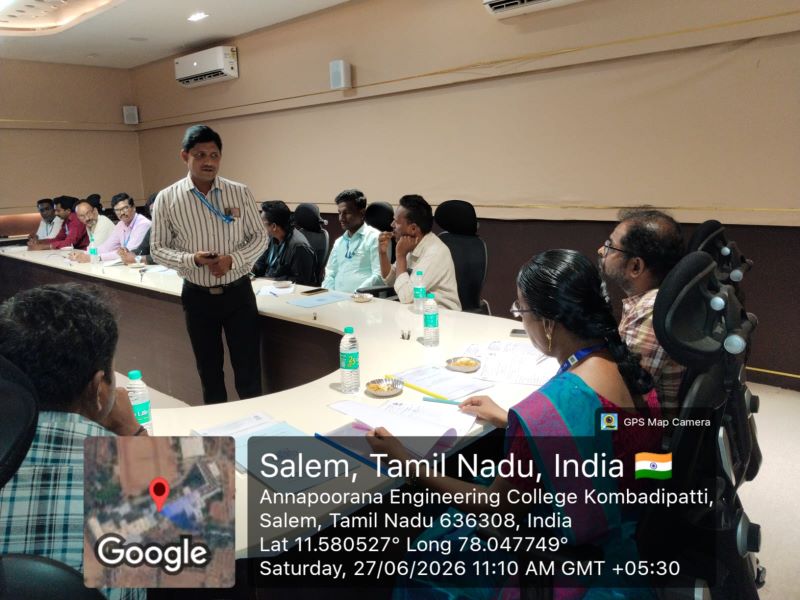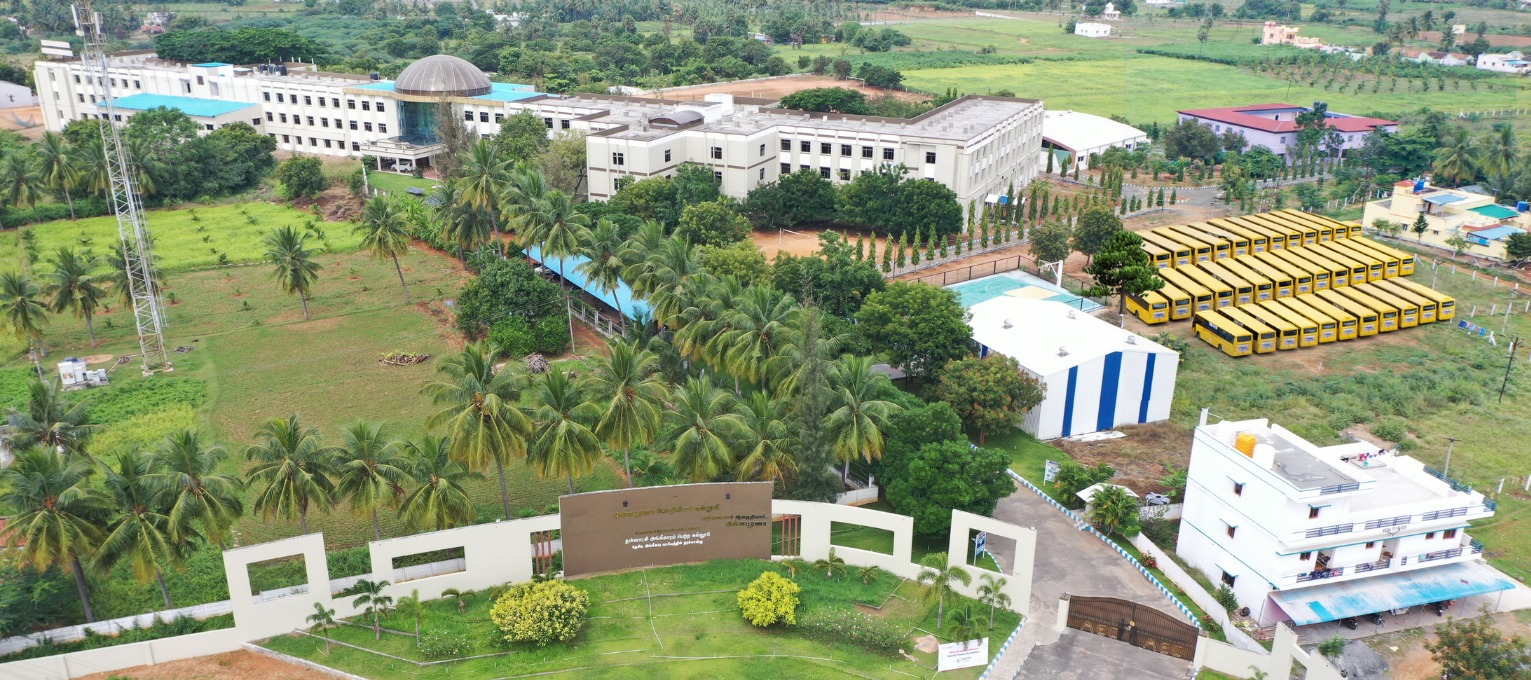
The Department of Mechanical Engineering at Annapoorana Engineering College (Autonomous) was established in 2010 with the vision of producing competent, industry ready mechanical engineers. Mechanical Engineering is widely regarded as an evergreen discipline, forming the backbone of industrial and technological development. The department offers comprehensive education in core areas including Applied Mechanics, Strength of Materials, Thermodynamics, Fluid Mechanics, Manufacturing Processes, Machine Design, CAD/CAM, and Automation. The curriculum is periodically updated to comply with university regulations, address industry requirements, and incorporate emerging technologies, ensuring relevance and academic rigor.
Well qualified and experienced faculty members, supported by modern laboratories and advanced computing facilities, create a strong environment for experiential learning. Emphasis is placed on project based learning, internships, industry interaction, workshops, seminars, and student participation in technical competitions. Graduates of the department are well placed in core industries, higher education, research organizations, and entrepreneurial ventures. The department continuously strives to nurture innovation, ethical values, teamwork, leadership, and lifelong learning, enabling students to confidently address professional responsibilities and global engineering challenges through quality education and sustained academic excellence initiatives.

Arise to the global level for outstanding education and research in Mechanical Engineering leading towards competent Mechanical engineers.

Engineering Graduates will be able to:
Graduates of Mechanical Engineering shall
Students shall have
State-of-the-art laboratories equipped with modern instruments for hands-on learning.
The Engineering Practice Laboratory serves as a well-structured learning environment where engineering fundamentals are transformed into practical skills through hands on training. The laboratory introduces first year students to essential workshop practices including fitting, carpentry, welding, plumbing, sheet metal work, electrical wiring and basic machining operations. It is equipped with fitting benches, vices, hand tools, carpentry tools, welding machines, drilling machines, grinders, sheet metal tools, electrical wiring boards, measuring instruments and safety accessories. Students are trained in the proper use of tools, machines and equipment with strong emphasis on safety, accuracy and workmanship. The laboratory promotes learning by doing, enabling students to understand material behavior, fabrication methods and real world engineering applications. Structured exercises and supervised practice sessions help develop problem solving ability, teamwork, discipline and technical confidence. The Engineering Practice Laboratory builds a strong practical foundation, supports skill oriented learning and prepares students for advanced laboratory courses, industrial exposure and professional engineering practice with focus on quality, safety awareness and continuous improvement and lifelong professional skill development initiatives.
The Manufacturing Technology Laboratory provides comprehensive practical training in conventional manufacturing processes essential for mechanical engineering education. The laboratory enables students to understand metal cutting principles, machining parameters, tooling, and surface finish through systematic experiments. It is equipped with centre lathes, milling machines, shaping machines, slotting machines, drilling machines, grinding machines, power hacksaws, tool holders, cutting tools, jigs, fixtures, and precision measuring instruments such as vernier calipers, micrometers, and surface gauges. Students perform turning, facing, tapering, threading, milling, drilling, reaming, shaping, and grinding operations under supervised conditions with strict adherence to safety practices. The lab emphasizes process planning, machine setup, tool selection, dimensional accuracy, and quality control. By linking theory with practice, the laboratory enhances understanding of manufacturing processes, material removal mechanisms, and production considerations. Hands on exposure develops technical competence, problem solving ability, and confidence to handle real industrial situations. The Manufacturing Technology Laboratory prepares students for advanced manufacturing courses, industrial training, and professional practice by nurturing precision, productivity awareness, and continuous improvement mindset in modern manufacturing environments globally.
The Kinematics and Dynamics Laboratory provides practical exposure to the fundamental principles governing the motion of machines and mechanical systems. The laboratory enables students to experimentally analyze displacement, velocity, acceleration, inertia forces, and dynamic behavior of mechanisms, thereby strengthening conceptual understanding through real-time observations. It is equipped with models and experimental setups such as four-bar mechanisms, slider-crank mechanisms, cam and follower systems, gear trains, governors, gyroscopes, flywheels, balancing apparatus, and vibration test rigs. Students conduct experiments to study velocity and acceleration analysis, balancing of rotating and reciprocating masses, gyroscopic effects, speed control mechanisms, and dynamic response of systems. Emphasis is placed on accurate measurements, graphical and analytical methods, and correlation of theoretical results with experimental outcomes. The laboratory promotes analytical thinking, problem-solving ability, and systematic experimentation while fostering teamwork and technical discipline. By integrating theory with experimentation, the Kinematics and Dynamics Laboratory builds a strong foundation for machine design, vibration analysis, and advanced mechanical engineering subjects, preparing students to address real-world challenges in mechanical system analysis and dynamic performance evaluation.
The Thermal Engineering Laboratory provides practical insight into the principles of heat transfer, thermodynamics, and energy conversion systems through structured experimentation. The laboratory enables students to understand the performance characteristics of thermal equipment and the application of theoretical concepts in real engineering systems. It is well equipped with experimental setups such as internal combustion engines, boilers, air compressors, refrigeration and air conditioning test rigs, heat exchangers, thermal conductivity apparatus, calorimeters, nozzles, and flow measuring devices. Students conduct experiments to evaluate efficiency, heat transfer rates, fuel consumption, and system performance under varying operating conditions. Emphasis is placed on accurate measurement, data analysis, performance testing, and safe operating procedures. The laboratory encourages analytical thinking, observation skills, and interpretation of results, strengthening the link between theory and practice. Through hands on exposure, students develop a clear understanding of thermal systems used in power plants, refrigeration, automotive, and process industries. The Thermal Engineering Laboratory builds strong technical competence and prepares students for advanced thermal courses, industrial applications, and professional engineering practice in energy related fields.

The CAD Laboratory provides comprehensive practical training in computer aided design and drafting essential for modern engineering practice. The laboratory enables students to convert engineering ideas into accurate digital models and drawings using industry standard software tools. It is equipped with high performance computer systems, licensed CAD software, advanced graphics support, and plotting facilities. Students are trained in 2D drafting, 3D part modeling, assembly modeling, surface modeling, and preparation of detailed engineering drawings with proper dimensions, tolerances, and annotations. Emphasis is placed on design standards, visualization skills, parametric modeling, and design modification techniques. The laboratory supports learning of product design, modeling accuracy, and interpretation of manufacturing drawings. Through hands on practice, students develop creativity, spatial ability, and technical confidence required for design oriented roles. The CAD Laboratory bridges the gap between conceptual design and manufacturing requirements, preparing students for advanced design courses, simulation studies, project work, and professional careers in design, manufacturing, and allied engineering fields.
The Metrology and Measurements Laboratory provides precise practical training in the science of measurement, inspection, and quality assurance essential for modern manufacturing and engineering practice. The laboratory enables students to understand standards, limits, fits, tolerances, and accuracy through systematic experimentation. It is equipped with precision instruments such as vernier calipers, micrometers, height and depth gauges, slip gauges, dial indicators, bore gauges, bevel protractors, surface roughness testers, comparators, tool makers microscope, profile projector, and coordinate measuring machine. Students perform experiments related to linear and angular measurements, surface finish evaluation, gear and thread measurement, alignment, and calibration of instruments. Emphasis is placed on measurement accuracy, error analysis, repeatability, and adherence to standard procedures. The laboratory strengthens attention to detail, analytical ability, and quality consciousness while linking theoretical concepts with industrial inspection practices. By developing measurement discipline and interpretation skills, the Metrology and Measurements Laboratory prepares students for quality control, production, research, and advanced manufacturing applications in precision driven engineering environments.
The Mechatronics Laboratory provides interdisciplinary practical training by integrating mechanical systems with electronics, sensors, control systems, and computing technologies. The laboratory enables students to understand the design and operation of automated and intelligent engineering systems through hands on experimentation. It is equipped with PLC trainers, microcontroller kits, sensors and transducers, actuators, pneumatic and hydraulic systems, motor control units, servo and stepper motors, data acquisition systems, and industrial automation modules. Students perform experiments related to sensor interfacing, PLC programming, electro pneumatic and electro hydraulic control, motor speed control, and basic robotics and automation applications. Emphasis is placed on system integration, logical control, troubleshooting, and safe operating practices. The laboratory promotes analytical thinking, innovation, and problem solving skills while encouraging teamwork and multidisciplinary learning. By linking mechanical engineering concepts with electronics and control technologies, the Mechatronics Laboratory prepares students for careers in automation, robotics, manufacturing systems, and smart industrial applications, while building strong foundations for advanced studies and industry oriented engineering practice.
The CAM Laboratory provides practical training in Computer-Aided Manufacturing, supporting modern manufacturing and production practices. The laboratory enables students to plan, simulate, and manufacture components using advanced digital manufacturing tools. It is equipped with high-performance computer systems, licensed CAM software, CNC programming modules, simulation tools, and machining interfaces. Students gain hands-on experience in tool path generation, CNC code development (G-code and M-code), machining parameter selection, and process planning for various manufacturing operations. Emphasis is placed on machining strategies, optimization of cutting parameters, virtual simulation, and error detection to enhance accuracy, efficiency, and productivity. Students learn to translate engineering drawings and 3D models into executable CNC programs for milling, turning, and other machining processes. Through structured laboratory exercises and project-based learning, students develop precision, analytical skills, and problem-solving abilities. The CAM Laboratory strengthens understanding of modern digital manufacturing workflows and prepares students for advanced manufacturing courses, CNC operations, industrial automation, and professional roles in production and manufacturing industries.
 Prof
ASP & Head
Prof
ASP & Head
 ASP
ASP
 ASP
ASP
 AP
AP
 AP
AP
 AP
AP
 AP
AP
 AP
AP
 AP
AP
 AP
AP
 AP
AP
Enhancing student skills beyond the curriculum through industry-relevant programs.
| Workshops / Conferences / Seminars / Symposium | Year | Title / Topic | Resource Person Name & Organization (if available) |
|---|---|---|---|
| Seminar | 2025 | Seminar On CAD for the Next Generation Engineer’s | Mrs.K.Jayasri Trainer & Designer, CAD Point. |
| Online Seminar | 2024 | Review on innovative design thinking and critical thinking | Dr. C. Pradeep Raja ADHOC Faculty, Department of Mechanical Engineering, National Institute of Technology, Andhrapradesh |
| Seminar | 2024 | Accelerators/Incubation-opportunities for students & faculties | Dr. R. Venkateshkumar, Assistant Professor. Department of Mechanical Engineering. B.V. Raju Institute of Technology. Narsapur, Vishnupur, Medak-502313 |
| Seminar | 2023 | Organizational Innovation | Mr. J. Boopathi Assistant Professor - Mechanical Engineering, Annapoorana Engineering College |
| FDP | 2023 | Product Design Engineering Using Autodesk Fusion 360 | Mr.S.R.Deviyaprasanth, Lead-Technical Trainer, ICT Academy |
| Seminar | 2023 | Member Benefits Of Professional Engineering Societies - SAEINDIA | Dr.K.RAJA Secretary - SAEISS Salem Division Associate Professor, K S Rangaswamy College of Technology, Tiruchengode. |
| Guest lecture | 2023 | World Environment Day Celebrations - Engineering And Design Thinking. | Mr.T.METHA CEO/Co-Founder Technojinn |
| Workshop | 2023 | Yukti Innovation Repository And Yukti Innovation Challenge | Mr. M.Raghunathan, CEO, Institute Of Industrial Design, Salem |
Bridging the gap between theory and practice through industrial exposure.
| Academic Year | Name of the company visited | Company Location |
|---|---|---|
| 2019-2020 | KAY JAY FORGING PVT LTD | Hosur |
| 2021-2022 | INSTITUTE OF INDUSTRIAL DESIGN | Salem |
| 2021-2022 | AEROSPACE ENGINEERING (P) LTD | Salem |
| 2022-2023 | SHANTHI GEARS | COIMBATORE |
| 2022-2023 | AEROSPACE ENGINEERING (P) LTD | Salem |
| 2023-2024 | METTUR THERMAL POWER STATION, | Salem |
| 2023-2024 | SAIL | Salem |
| 2023-2024 | AAVIN | Salem |
| 2024-2025 | METTUR THERMAL POWER STATION | Salem |
| 2024-2025 | AAVIN | Salem |
| 2024-2025 | SAIL | Salem |
| Academic Year | Company Name | Training Duration | Role / Area of Training | No. of Student Attended |
|---|---|---|---|---|
| 2024-2025 | INDO SHELL MOULD LIMITED, COIMBATORE. | 6 days | Moulding | 7 |
| 2024-2025 | SAKTHI AUTO COMPONENTS LIMITED | 6 days | Foundry | 7 |
| 2023-2024 | INDO SHELL MOULD LIMITED, COIMBATORE. | 6 days | Moulding | 7 |
| 2023-2024 | SAKTHI AUTO COMPONENTS LIMITED | 6 days | Foundry | 7 |
| 2022-2023 | STEEL PLANT,SALEM (SAIL) | 6 days | Heat Treatment | 7 |
| 2022-2023 | INDOSHELL MOULD LTD. COIMBATORE | 6 days | Moulding | 7 |
| 2021-2022 | INDOSHELL MOULD LTD. | 5 days | Moulding | 5 |
| 2021-2022 | MAGNA ELECTRO CASTING LTD. | 5 days | Metal Casting | 7 |
| 2020-2021 | SAKTHI AUTO COMPONENTS LTD. | 7 days | Foundry | 5 |
| 2020-2021 | INDOSHELL MOULD LTD. | 7 days | Moulding | 6 |
| 2020-2021 | MAGNA ELECTRO CASTING LTD. | 6 days | Metal Casting | 6 |
| 2019-2020 | INDISHELL MOULD LTD. | 11 Days | Moulding | 5 |
| 2019-2020 | SAKTHI AUTO COMPONENTS LTD. | 7 days | Foundry | 5 |
| 2019-2020 | SAIL, SALEM | 7 days | Heat Treatment | 4 |
Collaborations with industries and institutions for academic and research excellence.
| Organization / Company Name | Academic Year |
|---|---|
| IBM Software India (p) Ltd. | 2023-2024 |
| 3D BizTech – Coimbatore. | 2023-2024 |
| CADEPT TECHYS - Chennai. | 2023-2024 |
| ELECTRO CARE TECHNOLOGIES | 2020-2021 |
| SRIWIN ELECTRIC | 2020-2021 |
| CII- INDIAN GREEN BUILDING COUNCIL | 2019-2020 |
| MAXX CADD CENTER | 2019-2020 |
| SAKTHI AUTO COMPONENT LIMITED | 2018-2019 |
| THRIVENI CAR COMPANY | 2018-2019 |
| M M GEARS PRIVATE LIMITED | 2018-2019 |
| S S FASTENERS PRIVATE LIMITED | 2018-2019 |
| CADD CENTRE | 2017-2018 |
| PROLIFIC SYSTEMS & TECHNOLOGY PRIVATE LIMITED | 2017-2018 |
| S.No | Name | Designation | Position |
|---|---|---|---|
| 1 | Dr. M. Senthil | Head of the Department | Chairman |
| 2 | Dr. K. Ramanathan | Professor, Department of Mechanical Engineering, Alagappa Chettiar Government College of Engineering & Technology, Karaikudi | University Nominee |
| 3 | Dr. R. Prakash | Associate Professor, Department of Thermal And Energy Engineering, Vellore Institute of Technology | Academic Expert |
| 4 | Dr. J. Hamanandh | Associate Professor, Department of Mechanical Engineering, Sathyabama Institute of Science and Technology, Chennai – 600119 | Academic Expert |
| 5 | Dr. N. Kulasekharan | Metier Technical Leader, CFD Specialist, Valeo India Pvt. Ltd.,
Chennai Ph: 9444208826 Email: cfdsekar@gmail.com |
Industry Expert |
| 6 | Mr. M. P. Mohanraj | Associate Professor, Department of Mechanical
Engineering. Specialization: Thermal Engineering |
Faculty |
| 7 | Mr. M. Ranjithkumar | Assistant Professor, Department of Mechanical
Engineering. Specialization: CAD |
Faculty |
| 8 | Mr. P. Sakthivel | Assistant Professor, Department of Mechanical
Engineering. Specialization: Engineering Design |
Faculty |
| 9 | Mr. J. Boopathi | Assistant Professor, Department of Mechanical
Engineering. Specialization: Manufacturing Engineering |
Faculty |
| 10 | Mr. M. Govindaraj | Assistant Professor, Department of Mechanical
Engineering. Specialization: Refrigeration & Air conditioning |
Faculty |
| 11 | Mr. B. Prabhu | Assistant Professor, Department of Mechanical
Engineering. Specialization: Engineering Design |
Faculty |
| 12 | Mr. S. Kannan | Assistant Professor, Department of Mechanical
Engineering. Specialization: Engineering Design |
Faculty |
| 13 | Mr. E. Hariharan | Assistant Professor, Department of Mechanical
Engineering. Specialization: Welding Technology |
Faculty |
| 14 | Mr. A. Elamvazhuthi | Assistant Professor, Department of Mechanical
Engineering. Specialization: Thermal Engineering |
Faculty |
| 15 | Mr. K. Vigneshwaran | Application Engineer, Viyoma Computer Aided Manufacturing Pvt
Ltd, Hosur Ph: 9087654570 Email: vigneshwarankathalingam6@gmail.com |
Student Alumni |
Our alumni are making a mark across the globe in leading firms and institutions.
 2021 to 2025
2020 to 2024
2019 to 2023
2018 to 2022
2017 to 2021
2016 to 2020
2015 to 2019
2014 to 2018
2021 to 2025
2020 to 2024
2019 to 2023
2018 to 2022
2017 to 2021
2016 to 2020
2015 to 2019
2014 to 2018
Glimpses of department activities, events, and campus life.
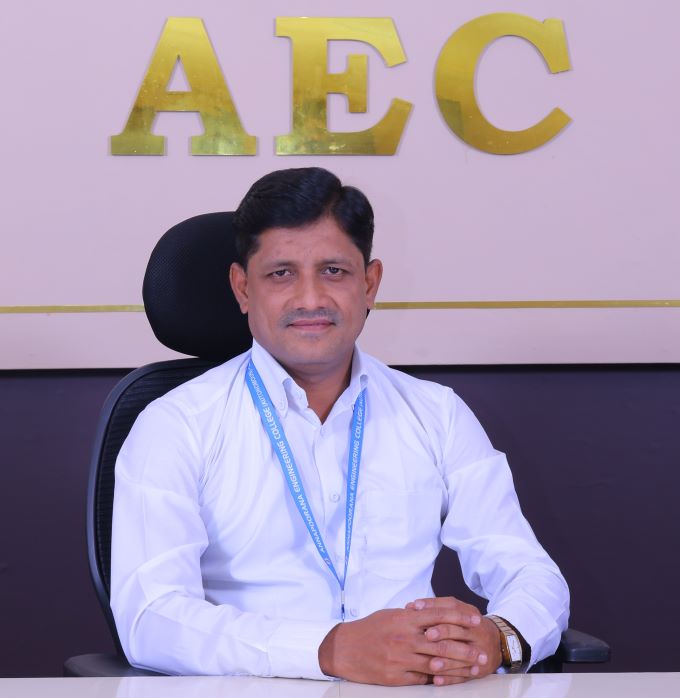
Reach out to the Head of the Department.
M.E., Ph.D.
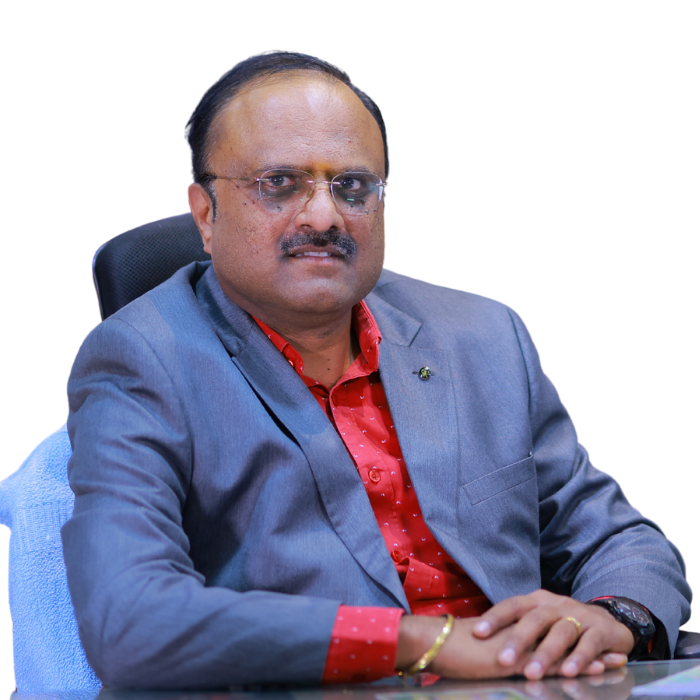
| Degree | Institute/Organisation | Specialisation | Year Of Passing |
|---|---|---|---|
| Ph.D | Anna University | Structural Engineering | 2005 |
| M.E | Anna University | Structural Engineering | 2002 |
| B.E. | Anna University | Civil Engineering | 2000 |
Content coming soon...
Content coming soon...
Content coming soon...
Content coming soon...
Content coming soon...
Content coming soon...